
Enterprise-level Logical Data Management Platform
Recognized by Gartner as a leading brand in Data Integration Tools for six consecutive years. Utilizing "data virtualization" technology, weave logical data without migration, enabling faster transformation of enterprise data assets into real-time data services driving AI and decision-making.


Beyond traditional data platforms, using "virtualization technology" to create an enterprise data brain.

Instantly identify business opportunities and eliminate decision-making delays caused by ETL.
No need to wait days for data migration scheduling; empower teams to gain real-time market insights and make decisions one step ahead.

Establish a single source of fact to eliminate cross-departmental data discrepancies
Establish a unified business semantic layer to ensure that the entire company communicates and makes decisions based on the same reliable data.

Unleashing core IT capabilities to break through data bottlenecks in business innovation
This frees IT teams from endless data extraction demands while empowering business teams with self-service analytics capabilities.
Which of the two Data Fabric paths would you choose?
Every enterprise wants to unlock the value of its data through Data Fabric, but different paths chosen will determine whether a project is more efficient or less effective. The table below compares the advantages and disadvantages of the traditional "physical consolidation" and Denodo's "logical consolidation" paths, helping enterprises grasp the latest, more efficient options.
x
Traditional Data Fabric approach
Logical Data Fabric approach | Denodo
Definition
A broad data integration architecture design that can blend multiple technologies

A Data Fabric architecture implemented using data virtualization as its core technology.
Integrative Thinking
Physical consolidation (ETL/ELT) and logical access: Let's move it to one place first.
Logical integration: No need to copy, use directly from the source.
Core technologies
Depends on ETL, data copying, and streaming.
Data Virtualization
Agility
Slow (months to years) If a large amount of ETL is involved, development and modification will be slow.
Fast (weeks to months): Rapid development speed, more agile response to changing business requirements.
Architectural Flexibility
Low (high modification cost)
High (ability to quickly adapt to business changes)
Data Real-time
Delay (depending on batch update)
Real-time
IT maintenance costs
High (requires maintenance of copied data and pipelines)
Low (simplified data architecture)
Impact on source system
Physical relocation may increase the burden on the source system.
The impact on the source system is minimal, and the original data remains unchanged.
Saved AI data preparation time
Compared to traditional data integration methods, it shortens data delivery time.
Faster data retrieval speeds and associated cost reductions
Delve into the core of the industry and solve your most challenging data problems.
Numerous systems, scattered data, and the need to balance speed and governance? This is precisely where Denodo's greatest value lies. Denodo's logical data architecture is designed to handle today's most complex data environments.

Financial Services Industry Data Platform
Instantly connects all new and legacy systems to meet stringent regulations and audits.
The proliferation of old and new systems creates data silos, impacting risk management and customer service efficiency. The Denodo Logical Data Platform integrates core systems instantly without data migration, providing a single, reliable source of data for anti-money laundering detection and risk management
How does Denodo create value?
Risk Management and Fraud Detection
Real-time transaction monitoring, anti-money laundering (AML) analysis, credit risk assessment.
Client Relationships and Wealth Management
360° panoramic view of customers, personalized product recommendations, and portfolio analysis.
Regulatory Compliance and Reporting
Data lineage tracing and cross-system regulatory reporting automation.
High-tech manufacturing data platform
Rapidly integrate supply chain data to enable smart factories.
Long and complex supply chains make it difficult to monitor production capacity and inventory in real time. Denodo quickly integrates data from ERP, MES, and other systems, providing real-time data for smart quality control and predictive maintenance, fundamentally improving yield and production efficiency .
How does Denodo create value?
Smart manufacturing and production line optimization
Real-time equipment monitoring, predictive maintenance, and product defect analysis.
Supply chain resilience and management
Real-time equipment monitoring, predictive maintenance, and product defect analysis.
Supply chain resilience and management
Shorten the design and testing cycle of new products.

Healthcare and Life Sciences Data Platform
Activating data while adhering to compliance accelerates clinical research.
Patient, genetic, and clinical data are highly sensitive and subject to strict privacy regulations. Denodo utilizes "data-free" technology to securely integrate disparate data without copying it, accelerating new drug development and clinical trials while ensuring data compliance.
How does Denodo create value?
New drug development and clinical trials
Clinical trial data analysis, biological data analysis.
Patient care and services
Linking health passbook data, patient journey tracking, and personalized medical advice.

Retail and e-commerce data platforms
Create a 360° customer view to drive omnichannel growth.
Customer data is scattered across multiple online and offline platforms, making it difficult to build a complete customer profile. Denodo quickly connects all customer touchpoints, instantly creating a complete 360-degree customer view, providing data fuel for personalized experiences and precision marketing.
How does Denodo create value?
Customer insights and personalized marketing
Omnichannel consumer behavior integration and personalized product recommendations
Inventory and Logistics Management
Real-time synchronization of sales, warehousing, and supplier data; automated replenishment.
Operations and Business Analysis
Real-time operations dashboard, marketing campaign performance evaluation

Government data platform
Integrating cross-departmental data to achieve a single-window service: Denodo
addresses the shortcomings of outdated systems and data silos between departments, hindering public service efficiency and data application. By rapidly integrating cross-departmental data, Denodo enables a single-window service, improving the quality of citizen services while ensuring data privacy and security .
How does Denodo create value?
Public services and smart cities
Cross-departmental data integration, one-stop services for citizens, and smart city applications.
Crisis Response and Decision Support
Epidemic tracking and emergency response.
Denodo's logical data management platform architecture
The Denodo platform employs an advanced layered architecture, with each layer dedicated to simplifying the complexities of data management and providing enterprises with unparalleled data agility and governance capabilities.

.avif)
Connect | Connect all data sources
The Denodo platform is underpinned by a powerful connectivity layer that acts like a universal adapter, seamlessly connecting all internal and external data assets within an enterprise without the need for prior copying.
Heterogeneous Source Integration
It supports over 200 data sources, easily connecting to everything from on-premises Oracle and SAP, cloud-based Snowflake and S3, to SaaS applications (Salesforce) APIs.
Instant Access
By adopting the "query-time integration" model, the latest data is retrieved directly from the source, completely eliminating the latency of batch processing.

Combine | Intelligent integration into a single view
This is the magic core of Denodo—the logic layer. Here, we use virtualization to integrate and transform scattered data, giving it a unified business meaning, without the need for time-consuming and laborious physical migration.遷
Logical Data Model (Semantic Layer)
Visual modeling tools make it easy to create a unified business view across systems (such as a "customer 360 view"), allowing everyone to understand data using the same business language.
AI-Powered Optimizer
The built-in AI engine automatically optimizes the query path to retrieve data from the underlying system in the most efficient way, ensuring optimal query performance while balancing speed and cost.

Consume | Diverse Delivery in Any Form
Once the logical data model is established, Dendo can "serve" this integrated data in various standardized and secure formats to any user or application that needs it.
Implementing Data as a Service
Data can be published as an instant API (REST/OData/GraphQL), a data source for BI tools (Tableau/Power BI), or directly accessible to data scientists via SQL/Python.
Integrated Data Catalog
Provides a Google Search-like interface, allowing business users to easily search, understand, and self-service access the data they need.

Govern | Comprehensive Governance and Security Management
Security and governance are the cornerstones of the Denodo platform, not add-on features. All data access is strictly controlled within a centralized platform.
Centralized Security Control
It provides granular role/column-level security and data masking to ensure that the right information is only visible to the right people, thus protecting enterprise data security.
Data Lineage Tracing
Clearly track the entire path of data from its source to its final application, easily meeting regulatory audit requirements.
Denodo brings you six competitive advantages
Denodo enables enterprises to build flexible, secure, and efficient data architectures through data virtualization.
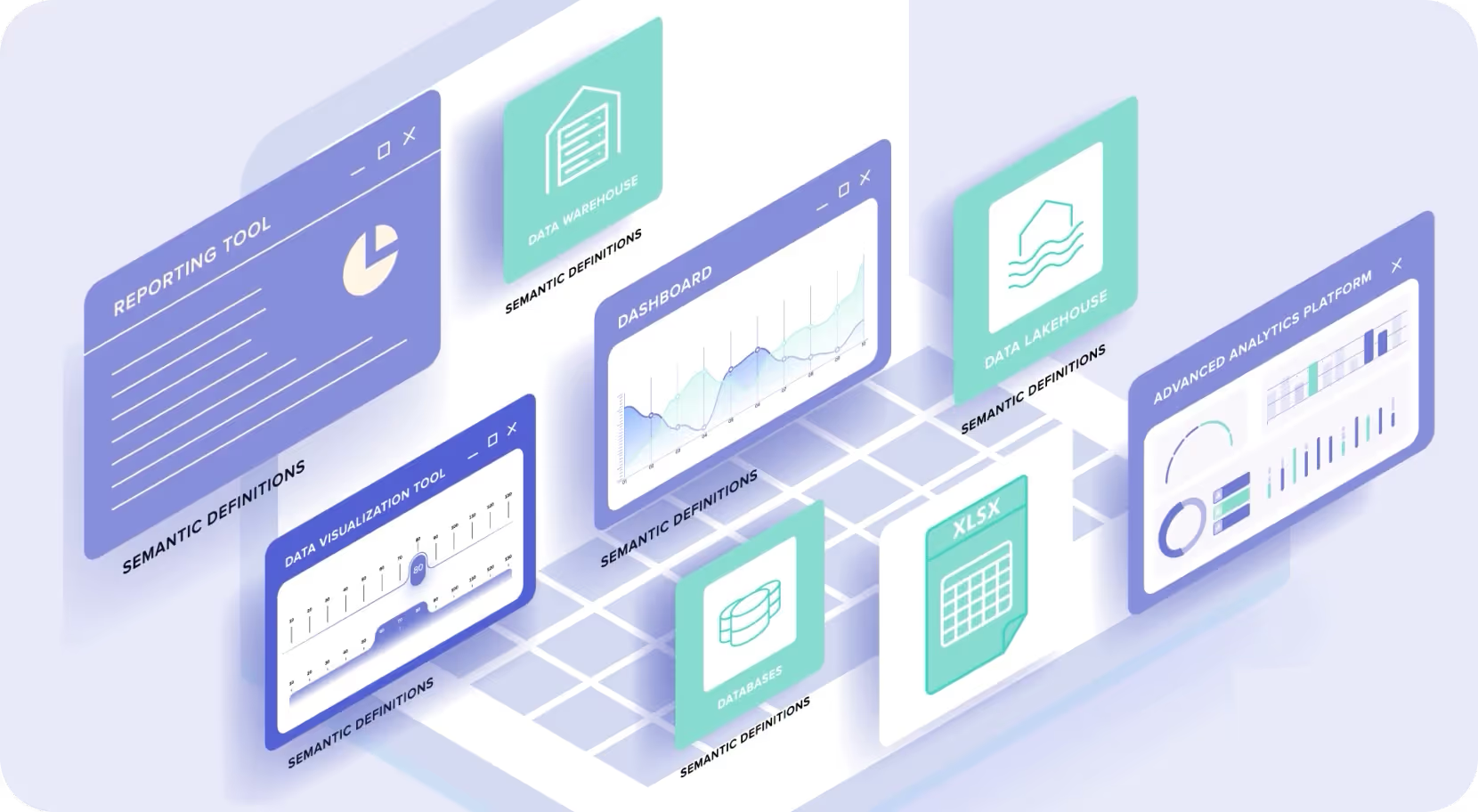
A unified semantic layer enables a single source of truth .
Through advanced logical data models, data from dozens of heterogeneous systems are integrated into a unified and easily understood business vocabulary. This ensures that everyone from the CEO to analysts sees the same reliable data, fundamentally resolving data inconsistencies.
Centralized Governance & Control
A single platform enables centralized security control over all data sources. It provides enterprise-level data governance capabilities certified by ISO/IEC 27001:2022, including granular access control, data lineage tracing, and audit logs to ensure data asset security and compliance.
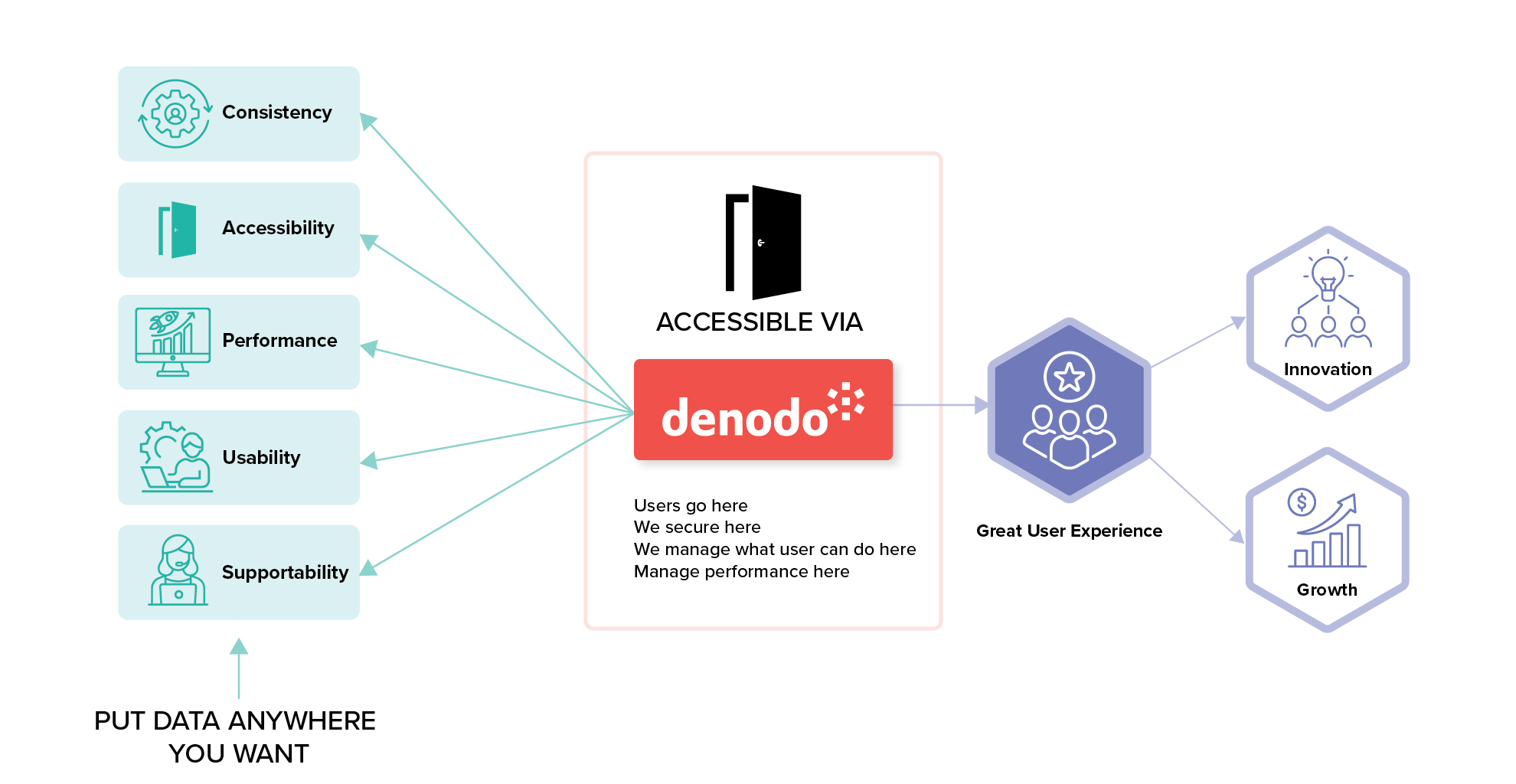

Self-Service Analytics & Discovery
Give data insights back to business experts! With a built-in integrated data catalog and visual query interface, business users can independently explore and analyze the data they need, reducing the data insight cycle from weeks to hours, without relying on IT.

Instant integration and flexible architecture
No need to wait for lengthy data migration. The platform supports the instant integration of over 200 cloud and on-premises data sources and perfectly supports any elastic architecture, including existing and future multi-cloud and hybrid cloud environments.

AI-driven intelligent query efficiency
The platform's built-in AI engine and dynamic caching mechanism automatically optimize query paths, ensuring high-performance data access services for front-end applications even with large datasets , improving query efficiency by tens of times.

Diversified data services accelerate the implementation of AI applications
Provide AI teams with a continuous stream of real-time data! Publish any integrated data as an API or BI data source with a single click , significantly reducing data preparation time in AI/ML model development and accelerating the implementation of innovative applications such as smart manufacturing and precision marketing.
Embark on a data transformation journey and build a new generation of data ecosystem together.
Is your company facing challenges such as data silos and delayed decision-making? Contact our professional consultants today to explore how Denodo can help your business achieve data-driven growth through more efficient data management, making data the core engine driving decision-making and innovation.
